Magic: The Gathering Arena
- 4.2
- Rating
- 5.00M
- Installs
- Free
- Price

 Analysis by App-foxy
I came to Magic: The Gathering Arena expecting a digital card game that would be easy to pick up for a few casual matches. It is that, but only up to a point. Arena brings the long-running Magic card game to mobile in a form that feels much closer to a full tabletop-style experience than a simplified card battler. That depth is its biggest attraction, and also the main reason it can feel demanding.
After spending time with it, I see Arena as a strong choice for players who enjoy planning several turns ahead, learning complicated interactions, and gradually building a collection. It is less suitable if you want a quick game with very little reading, instant access to every option, or a relaxed experience that never asks you to study rules. The right decision depends less on whether you like card games in general and more on how much strategy and learning you want from one.
What to consider before choosing Arena
The first question I would ask a new player is whether they want a card game or a collectible card game. Arena is firmly in the second group. You do not simply choose from a fixed set of cards and play identical matches forever. You learn the rules, collect cards, assemble decks, adjust those decks, and slowly become better at recognizing patterns. That ongoing process is central to the experience.
You May Also Like

 Blood Strike: 2.5 Anniversary
Blood Strike’s Loadouts Turn Every Drop Into a Tactical Gamble
A close look at Blood Strike’s custom loadouts: how fast access to signature weapons reshapes its battle royale rhythm, rewards preparation, and narrows the gap between fights.

 Pandora - Music & Podcasts
Pandora’s Music Is Easy to Start, but Harder to Recover
Pandora’s strength is its low-effort path from a seed to a station. Its weak spot is how much confidence it asks you to place in connection, setup, and quiet recovery.

 8 Ball Pool
 Is Built on Rivalries, Rematches, and Routine
A close look at the rivalries, rematches, shared routines, and unanswered safety questions that turn a quick pool match into a persistent mobile community.

 Samsung Music
’s Quiet Strength Is Playing What You Already Own
Its reach comes less from spectacle than from dependable access to a personal library. That simplicity is both the app’s strongest retention engine and its ceiling.

 AccuWeather: Weather Radar
AccuWeather Review: A Quick, Clear Forecast for Everyday Decisions
For everyday plans, the best forecast is the one you can understand quickly. AccuWeather makes rain timing, radar, and local conditions easy to act on, with a few trade-offs.

 Hill Climb Racing
Why Hill Climb Racing Still Turns Crashes Into One More Run
A tiny car, a bumpy hill and one more upgrade: Hill Climb Racing keeps resurfacing because its simple chaos makes every near-miss feel personal.
More From Our News Desk



The game is developed by Wizards of the Coast LLC and is available as a free game for Android. Its age guidance is Teen, which makes sense because the rules, fantasy presentation, and competitive structure are aimed at a more mature audience than a very simple family card game. The minimum Android requirement is 7.0, so the software is accessible on many older devices, although the experience will still depend on how well a particular phone handles a visually active card table.
I would also think about how comfortable you are with reading. Cards carry abilities, conditions, costs, and timing details, and the important difference between a good move and a bad one is often hidden in wording rather than artwork. A newcomer can learn, but the learning curve is real. If you prefer games where the rules are explained almost entirely through icons and short prompts, Arena may feel heavy at first.
Another useful decision criterion is patience. A match can be satisfying because each action matters, but that also means you cannot always play on autopilot. You may need to hold a card for a later turn, leave resources available for a response, or avoid using a powerful effect simply because it is available now. The game rewards restraint as much as aggression.
For someone deciding between Arena and a more casual mobile card game, I would compare four things: how much strategy you want, how willing you are to learn a large ruleset, whether you enjoy collecting, and how much control you want over deck construction. Arena is strongest when all four answers lean toward “yes.”
The first sessions are about learning how to think
The early experience is not just about memorizing card names. It teaches a different way of looking at a match. You begin by asking what you can do this turn, but you soon need to ask what your opponent might do next, which resources they are holding back, and whether your current play reveals too much information.
That change in thinking is one of the best parts of the game. I found that even a short match could leave me considering a decision several turns earlier. A creature that looked useful immediately might have been better saved. A removal card might be tempting, but using it too soon could leave me helpless against a more important threat. These are not decorative choices; they are the heart of the experience.
New players should resist the urge to judge their first losses too harshly. In Arena, losing often shows that a deck has a structural problem rather than proving that every individual move was wrong. If you repeatedly run out of cards, fail to use your resources, or cannot answer a certain type of threat, the solution may be to change the deck rather than play faster.
Where the mobile version wins
Arena’s biggest strength is that it preserves the identity of Magic instead of reducing it to a basic matching game. The battlefield has enough room for meaningful decisions, and the cards interact in ways that create unusual situations. I never feel that the game is merely asking me to follow a fixed sequence. The board state can change quickly, and a careful player can often find a line that is not immediately obvious.
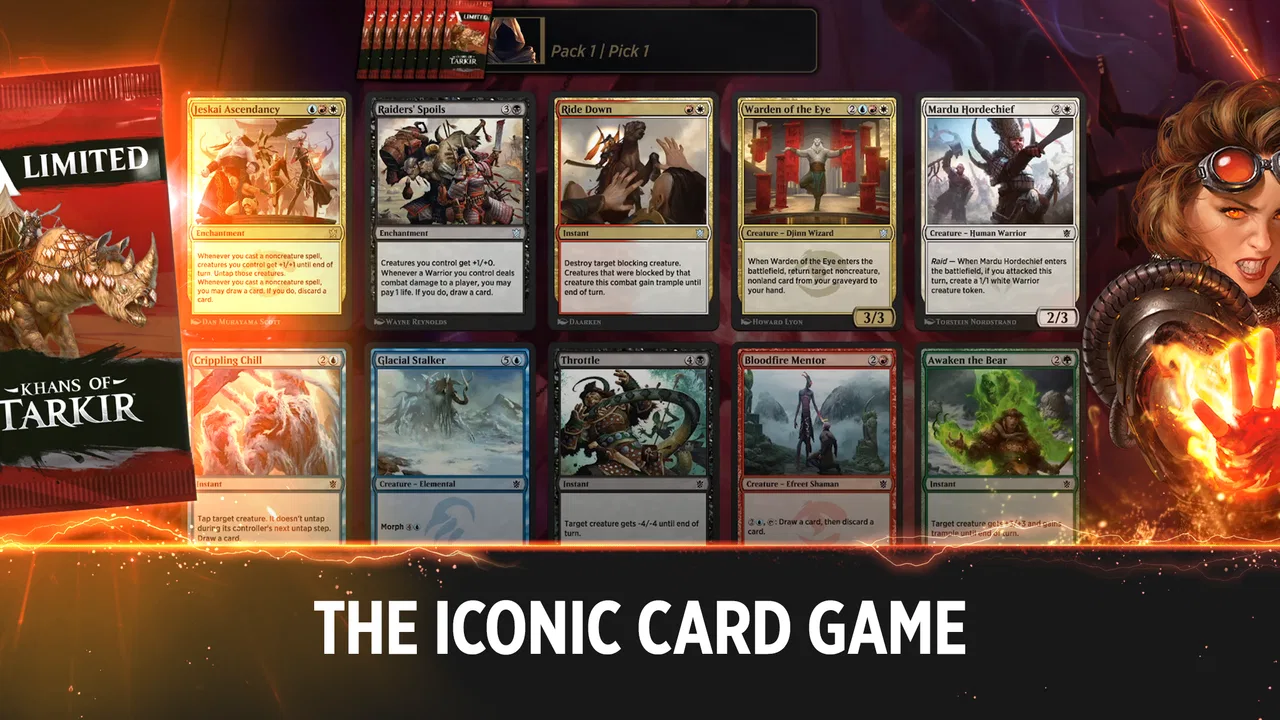
The interface is also more helpful than a physical table when it comes to tracking complicated effects. Cards can be inspected, actions are presented in an organized way, and the game handles much of the bookkeeping. That makes the digital format especially useful for people who like Magic’s rules but do not enjoy manually counting every detail or checking every trigger.
Another advantage is convenience. A physical collection requires cards, storage, and a place to play. Arena puts the match directly on a phone, which makes it practical for a quiet break, a commute with a stable connection, or an evening when you want a strategic game without preparing a table. I would not call every match short, but the convenience of starting a game is excellent.
The game also works well as a training space. I can test a deck idea, notice which cards sit unused, and learn how different effects behave without needing another person to organize a session. That makes experimentation less intimidating. Instead of waiting until a deck feels perfect, I can try a rough version and improve it through actual play.
The most valuable habit is to treat every match as information, not only as a win-or-loss result. After a game, I recommend asking which cards were dead in hand, which turns felt crowded, and whether the deck had a clear plan. This simple review process improves decision-making faster than changing cards randomly after every defeat.
Three practical insights that are easy to miss
First, deck construction is not just about adding the strongest cards you own. A powerful card can still be wrong for a deck if it does not support the deck’s main plan. When I evaluate a new card, I ask what turn I want to play it, what it replaces, and whether it helps me recover when the opponent is ahead. This prevents the common beginner mistake of building a pile of impressive cards that does not work together.
Second, the best time to learn a card is before the match becomes complicated. I make a point of opening unfamiliar cards and reading their full text when the board is calm. Waiting until a critical turn often leads to rushed decisions. Understanding a card’s timing in advance can be more valuable than knowing that it is considered strong by other players.
Third, resource management is a hidden skill. It is easy to focus on creatures or dramatic effects, but the cards and resources available several turns later often decide the result. I try to avoid spending everything merely because I can. Keeping a flexible option can make the opponent respect a possible response, even when I do not actually use it.
A fourth insight is that the mobile format changes how I approach sessions. I would not begin a serious match when I have only a minute or two available. A better routine is to use short breaks for reviewing cards or adjusting a deck, then start a match when I can give it proper attention. That avoids turning a thoughtful game into a frustrating interruption.
How Arena compares with other card-game choices
Compared with a simple digital card game, Arena offers far more room for long-term improvement. Casual alternatives may be easier to understand immediately and may deliver a quicker sense of progress. They are often better for someone who wants a short, low-pressure activity. Arena wins when the appeal is making meaningful choices and slowly understanding why a particular line of play works.
Compared with a fixed-deck card game, Arena gives me much more control over how I want to play. That freedom is exciting, but it also creates responsibility. A fixed-deck alternative can provide a cleaner introduction because the game designer has already made many of the construction decisions. Arena expects me to participate in those decisions, and that can be either a major benefit or an unwanted chore.
Compared with playing physical Magic, the app is easier to access and handles the administrative work. The trade-off is that a phone screen does not provide the same social atmosphere as sitting across from another person with real cards. If the main reason you love card games is conversation, collecting physical artwork, or the ritual of a tabletop session, the mobile app cannot fully replace that experience.
I would also distinguish Arena from games built around a single, highly predictable strategy. Those games can be comforting because you know exactly what your deck is trying to do. Arena is more open-ended. That means more discovery, but also more moments when I had to admit that I did not yet understand why a deck was failing.
Collection building and the cost of changing direction
The game itself is free, which makes trying it straightforward. There are in-app purchases ranging from $4.99 to $199.99 per item, so players should think carefully before spending. I would not recommend buying anything immediately. The first priority should be learning which styles of deck you actually enjoy and whether you are likely to keep playing long enough for a larger collection to matter.
The real cost is not only money. It is also attention. Building a collection takes time, and changing from one style to another can make earlier choices feel less useful. That does not mean experimentation is a mistake, but it does mean I would choose a direction gradually. Play several different approaches, notice which decisions feel natural, and then invest effort in the one you genuinely want to understand.
A useful workflow is to keep one reliable deck for learning the basics and one experimental deck for testing ideas. The reliable deck gives you a stable reference point, while the experimental list lets you explore without constantly rebuilding everything. This approach also helps identify whether a loss came from a weak strategy, unfamiliar cards, or a simple play error.
I would be cautious about copying a deck without understanding it. A list can look excellent and still perform poorly in your hands if you do not know which cards are essential, which are flexible, and which should be saved for a particular situation. Before changing a copied deck, play enough games to identify its intended plan. Otherwise, you may remove an awkward-looking card that was quietly holding the whole strategy together.
Performance, comfort, and everyday use
On a phone, the interface needs to make complex play readable without making the screen feel crowded. Arena generally succeeds at presenting a lot of information in a compact space, but new players may still need time to understand where to look. I recommend slowing down during the first sessions rather than trying to match the pace of experienced players.
Touch controls are convenient for selecting cards and confirming actions, but they can make precision more important than expected. I take an extra moment before committing to a move, especially when several effects are available. A quick tap is not always the best tap when the consequences of an action can shape the entire match.
For an everyday scenario, imagine having twenty minutes after dinner. I might use the first few minutes to check a deck, play one match, and then review the turn where the game changed direction. That is a good use of Arena because it combines entertainment with gradual improvement. By contrast, if I am waiting in a line and expect to be interrupted constantly, I would choose something less demanding.
The game has a 4.1 average from around 279 thousand ratings, with more than 5 million installs. Those figures suggest a substantial mobile audience, but they do not change the personal fit question. A popular card game can still be wrong for someone who dislikes reading, collecting, or losing while learning. I would use the broad audience as a reason to try it, not as proof that every player will enjoy it.
Who should skip it
I would skip Arena if I want a game that explains everything in seconds and lets me win through quick reactions. Its best moments come from planning, not speed. I would also look elsewhere if I dislike games where collecting and deck development are part of the long-term loop.
Players who mainly want a social tabletop atmosphere may prefer physical play or a more directly conversational digital option. Arena can connect me with opponents through matches, but it does not recreate the full feeling of sharing a table with friends. Likewise, anyone who finds complex card text tiring may have a better time with a lighter alternative.
I would be careful recommending it to a child simply because it is free. The Teen rating reflects the amount of strategy and the nature of the content. Younger players may enjoy the fantasy theme, but they may need guidance with rules, spending decisions, and the patience required to build a collection gradually.
Who gets the most from it
Arena is a particularly good fit for someone who has seen Magic before and wants a convenient way to play without carrying cards around. It is also a strong choice for a strategy fan who enjoys learning systems and improving through repeated decisions. Even a player new to Magic can enjoy it if they are comfortable treating the first sessions as lessons rather than expecting immediate mastery.
I think it suits analytical players who like asking “what if?” after a match. The game gives those questions somewhere to go. You can reconsider a turn, adjust a deck, and test a different plan. That loop feels much more rewarding here than in a card game where every match follows nearly the same pattern.
The current version is 2026.56.10.5662, and the game was released on March 17, 2021. I mention that because Arena is not a brand-new experiment; it has had time to establish itself as a mobile way to approach Magic. Still, its established nature should not be confused with simplicity. It remains a game that asks players to invest attention.
My recommendation
I recommend Magic: The Gathering Arena to readers who want a serious digital card game with meaningful deck building and enough depth to reward months of practice. I would start for free, spend time learning the basic patterns, and avoid making purchases until I knew which style of play I wanted to pursue.
My strongest advice is to judge the game after learning its rhythm, not after the first confusing match. Read cards carefully, keep one dependable deck while experimenting, and review losses for patterns instead of blaming luck. Those habits make the early experience much less frustrating.
If you want a fast, uncomplicated mobile diversion, choose a lighter card game instead. If you want the strategic texture of Magic in a convenient phone format, Arena is one of the more convincing options in its category. It asks more from me than a casual alternative, but when I am in the mood to think through every turn, that demand is exactly why I keep coming back.
FAQs for Magic: The Gathering Arena
01What are the system requirements for Magic: The Gathering Arena on mobile?
Magic: The Gathering Arena requires a device running Android 6.0 or later, or iOS 13.0 or later. For Android, it is recommended to have at least 4GB of RAM and a Snapdragon 835 processor or equivalent. For iOS, an iPhone 6S or later is recommended for optimal performance. Ensure your device meets these requirements for a smooth gaming experience.
02Is Magic: The Gathering Arena free to play?
Yes, Magic: The Gathering Arena is free to download and play. However, it features in-app purchases for booster packs, cosmetics, and other in-game items. While you can earn cards and rewards through gameplay, some players may choose to buy these items to enhance their collection or progress more quickly.
03Can I play Magic: The Gathering Arena offline?
No, Magic: The Gathering Arena requires an internet connection to play. The game involves live matches against other players and needs to connect to servers for updates, card collections, and matchmaking. Ensure a stable internet connection to enjoy uninterrupted gameplay.
04How does the matchmaking system work in Magic: The Gathering Arena?
The matchmaking system in Magic: The Gathering Arena is designed to pair players of similar skill levels. It uses a hidden matchmaking rating (MMR) to find opponents with comparable experience and ability. This ensures balanced and competitive matches, providing a fair playing field for all participants.
05Are there regular updates and new content in Magic: The Gathering Arena?
Yes, Magic: The Gathering Arena receives regular updates that include new sets, events, and game features. The developers frequently release new cards and mechanics aligned with the physical card game. Players can expect fresh content and improvements, keeping the game engaging and up-to-date.
Pros
- Stunning graphics bring the cards to life.
- Frequent updates with new content.
- User-friendly interface for new players.
- Cross-platform play enhances accessibility.
- Rewarding progression system.
Cons
- Occasional server issues disrupt gameplay.
- Limited offline play options.
- High learning curve for beginners.
- Microtransactions can be expensive.
- Deck-building can be complex.

Magic: The Gathering Arena
Gallery